Unknown Unknown | November 20, 2025
The Travel Authorization Edition
On inter-village visas, the new ETIAS system, and the true end of the end of an era.

The problem with business software: it’s built for everyone, which means it’s built for no one.
Aboard flips that. Tell us what you need, get an AI prototype in minutes, then our engineers customize it for your exact processes. Custom solutions without custom timelines.
Guan Yang (GY) is a data scientist based in New York. He currently holds two ETAs.
Guan here. Some time in 2026, after several delays, the European Union will roll out the ETIAS system, requiring most visitors to the Schengen area on tourist visas to apply online in advance for permission to travel. This will apply even to visitors who currently do not require a visa. The EU will follow in the footsteps of the United States (2008), Canada (2016), New Zealand (2019) and the United Kingdom (2025).
Why is this interesting?
Visa-free travel to rich countries has long been a privilege only enjoyed by citizens of a select club of other rich countries. But what a privilege it was: one could jet off for last-minute business meetings or go for an impromptu jaunt to New York, London or Paris without a slow, expensive and annoying visa application. There was always the possibility of scrutiny at secondary inspection, but that was rare. Even students, young people, those between jobs or with minor scrapes with the law—groups that traditionally have difficulty getting a visa—could go on an American road trip or a European rail holiday without much worry.
Freedom of travel has ebbed and flowed over the centuries. In 13th-century England, one needed documents to go from one village to the next. Travel was tightened dramatically over the course of the French Revolution and the ensuing wars, leading to the introduction of the first modern passports (initially issued by the country one traveled to), and restrictions were reimposed in the wake of the revolutions of 1848. The golden age of free travel in Europe was arguably the brief period between the relaxation of the post-1848 rules and the breakout of World War 1.
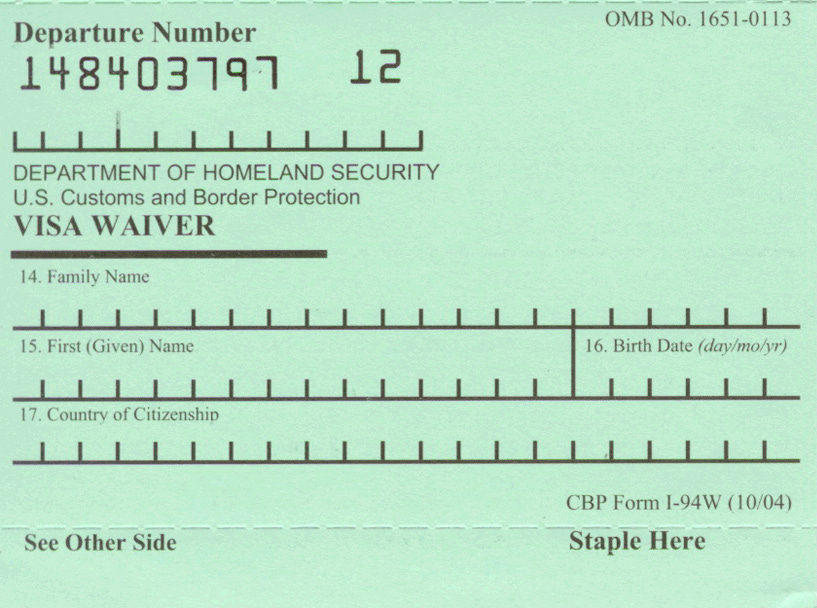
After World War 2, the United States signed bilateral agreements with various European countries so that American visitors could visit Europe visa-free, while Europeans could obtain American visitor visas without a fee. Finally, in 1986, the US fully reciprocated with the Visa Waiver Program, with its famous green I-94W forms, inaugurating the era of true visa-free visits to the US. That would last for two decades until the ESTA system was launched in 2008, requiring travelers flying to the US to apply online for permission in advance. ESTA would later be expanded to land travel in 2022. Many a traveler has tried to apply or renew at the last minute at the airport, anxiously waiting to see if it would be approved in time.
Although much less onerous than visas, these electronic travel authorizations make it much easier for states to screen out travelers with a criminal record or to filter visitors based on factors such as age, employment (or lack thereof), income, place of residence and previous travel history. Names can be checked against lists of political undesirables. One might also be denied on account of having the same name as an undesirable or due to some algorithmic fluke. It was always possible to send people back on arrival, but that was more paperwork and expense than a simple denial of an online application, which may not even require human involvement.
If the creation of the US ESTA in 2008 marked the beginning of the end of true visa-free travel among the wealthiest states, the introduction of EU ETIAS in 2026 represents the end of the end. Enjoy it until then! (GY)
Bonus link: Our Passports, Neil Kaplan’s wonderful collection of historic passports. Also on Instagram.