Unknown Author | March 3, 2026
The Plastic People Edition
On real-world testing, depressurized rooms, and London nightclubs.
Note: I recently watched an excellent clip about sound—and about Plastic People in particular. It helped me finally get my thoughts together about the place. It’s worth your time.
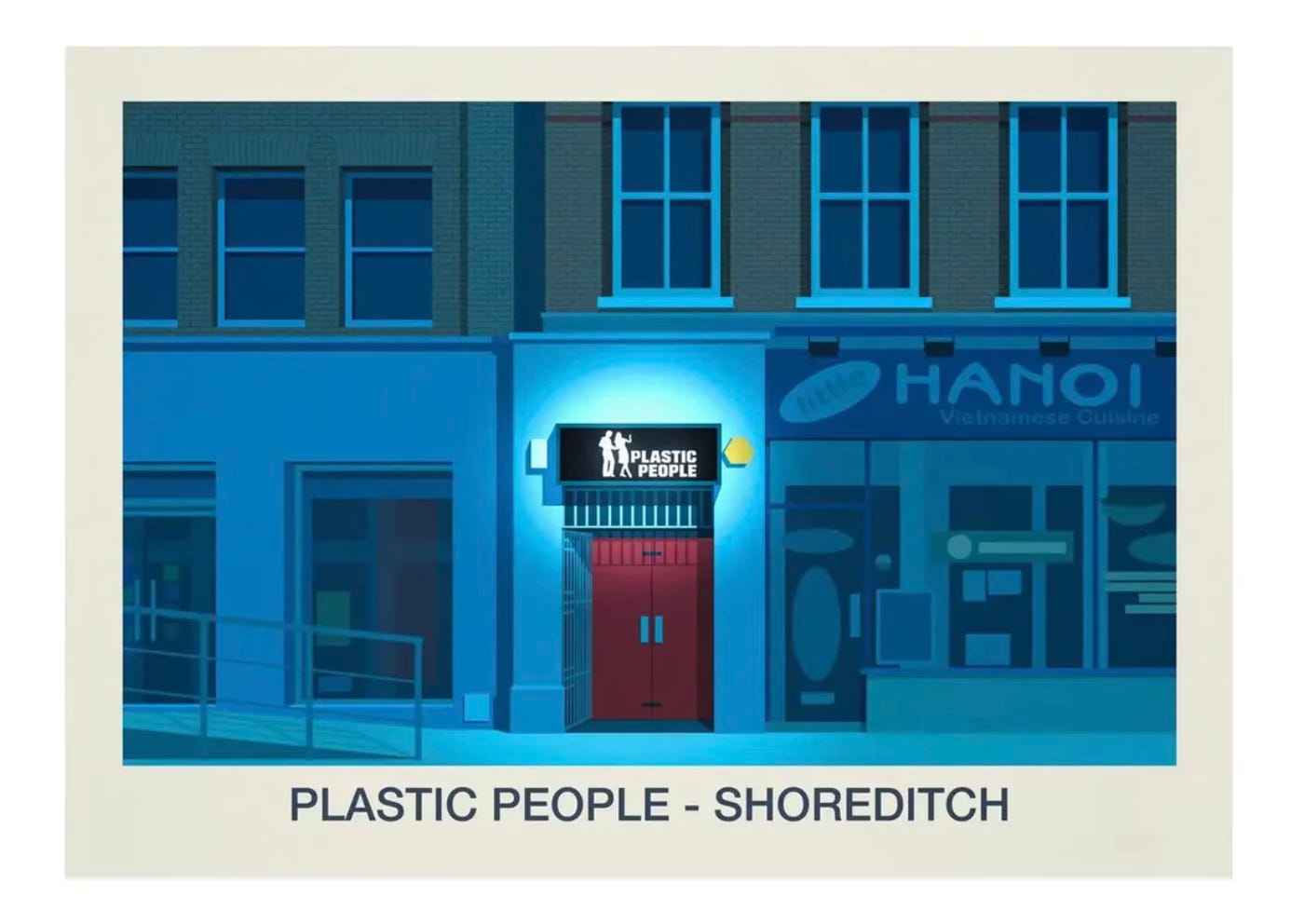
Colin here. The first time I went to Plastic People—the London nightclub that closed its doors in 2015—it was on a weeknight. Nothing notable was meant to be happening. The room was simply open.
Inside, two DJs who were already well known—James Lavelle and Craig Richards—were behind the decks, playing records without ceremony. It was a far cry from their high-profile London residencies at places like Fabric. There was no sense of “tweaking the Allen and Heath mixer” performance, and no attempt to command the room.
It felt much more casual, depressurized and even provisional. A track would come in, sit for a minute, then disappear. Another would follow. The sound system made everything legible. You could hear what held the room, and what quietly fell flat.
Early on, it felt less like a club than a working session.
Why is this interesting?
Plastic People existed as a spiritual counterweight to Fabric, which at the time defined London nightlife through scale and ambition. Fabric was where scenes presented themselves to the world. Plastic People was where those scenes were quietly worked out. Smaller, darker, more exacting like an actual B-side.
The room itself encouraged attention. It was compact, with almost no visual distractions. The ceiling was low—at least as I remember it—and you stood close to the booth, close enough to feel the speakers pushing the air.
That emphasis was deliberate. As founder Ade Fakile told The Guardian, “My main aim with Plastic People was to give DJs around the world an incredible, clean sound system, and somewhere they could truly play whatever they wanted.” Everything else was secondary. Sound was the infrastructure.
Plastic People was also early to CDJs, which collapsed the distance between production and actuality. DJs could bring tracks almost immediately after finishing them on a computer and hear them through a serious system at two in the morning, in front of people who knew how to listen. Fakile described the problem it was designed to solve simply: “Sometimes you listen to a song at home and think it sounds amazing. You go out, someone plays it, but it doesn’t quite sound the way you know it.” Plastic People existed to close the gap between the studio and the room.
That created a fast, embodied feedback loop. Tracks weren’t validated by reputation or hype, but by whether they could hold a room without forcing it. And because the space was small, the boundaries blurred. DJs, producers, and regulars stood together as part of the ongoing calibration.
Nothing about Plastic People seemed designed to grow. It wasn’t trying to define a movement or package a sound. It felt to me like a place where restraint was rewarded, a place to pressure-test before anything hardened into a statement.
That’s why it felt like the coolest room in London. There is real value in that kind of space—learning how a track breathes, how it responds to bodies and walls and air. Making something work in a studio is one thing. Letting it play out on a serious system, in a lower-stakes room, is where you learn what survives contact with the physical world. (CJN)