Noah Brier | August 7, 2026
The Park Hyatt Tokyo Edition
On familiarity, renovation, and service culture
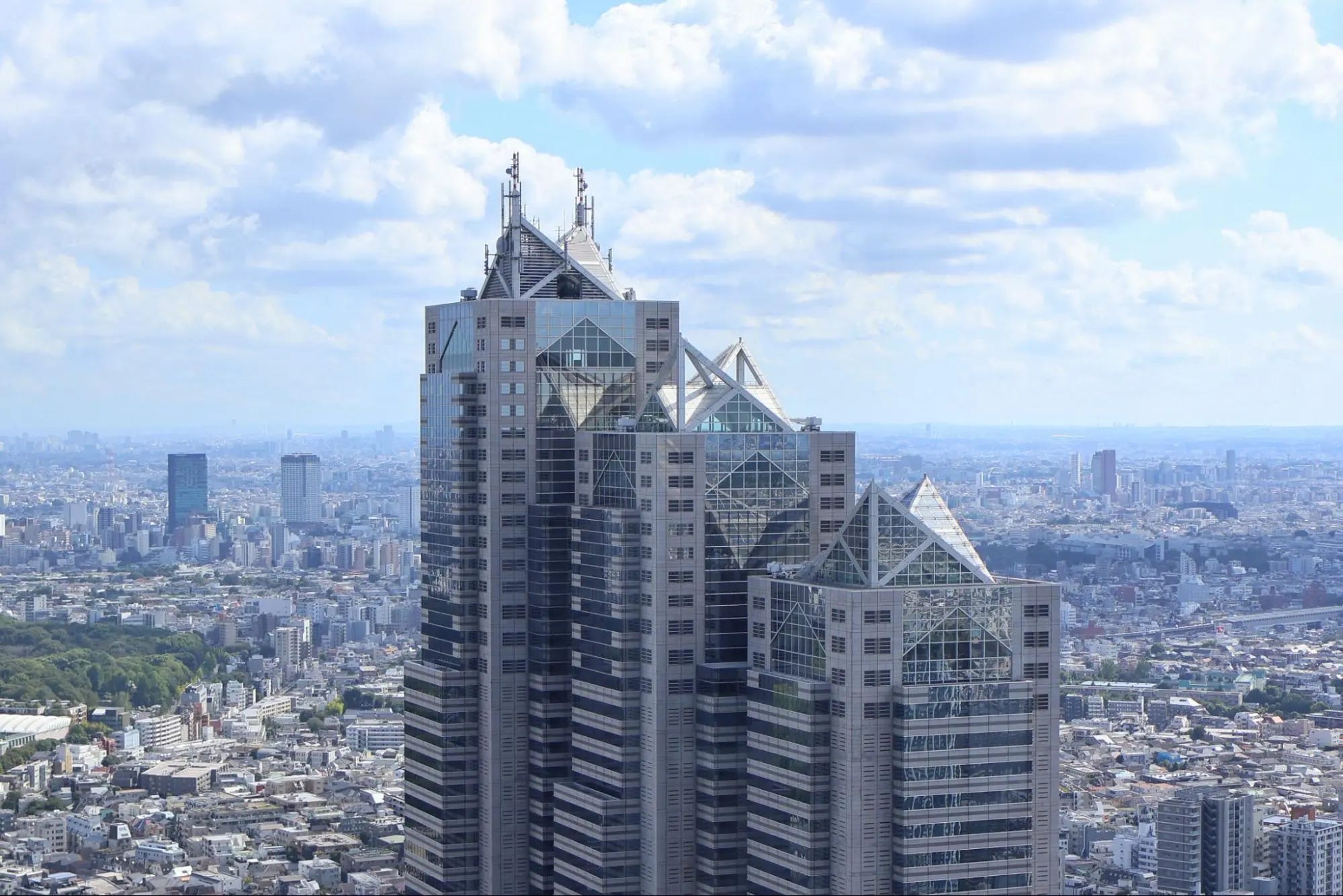
This originally appeared in my Skift column. Reposting with permission.
I can still remember the first time I booked the Park Hyatt Tokyo on the old Hyatt website, my finger hovering over the confirm button. It was 2008 and the rate felt like a dare to my bank account. I hesitated, did the mental math one more time, and clicked anyway because I knew I wanted to experience it.
The hotel became my haven in Tokyo — I’ve been there nearly 50 times since. I’ve celebrated birthdays there, hosted a rotating cast of friends, and ate at the New York Grill more times than I can count. The relationship deepened: staff came to know me better, and their hospitality became more anticipatory, subtle, and nuanced. I came to know the building: its rhythms, atmospherics and peculiarities.
There is the faint wind that moves through the elevators. The black Japanese crows flying and cawing in the thermal updrafts outside the 47th floor. I knew the side of the building to request for winter views of Mount Fuji. The bronzed wristwatch sculpture in the entryway that first-time visitors mistake for a lost Rolex.
Then there’s the hush and perfectly curated books of the library, and the large map book opened to Japan. The sea-foam colored Le Corbusier chairs, positioned at precisely the right angle, as they have been for decades. More than any individual object, I knew the story the hotel told as you moved through it.
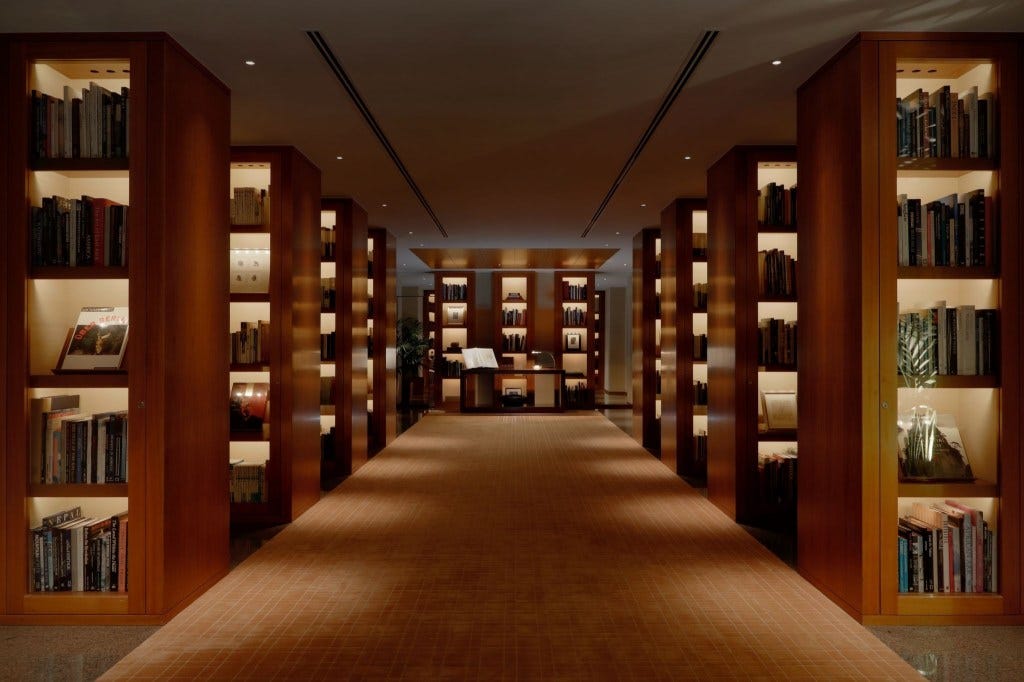
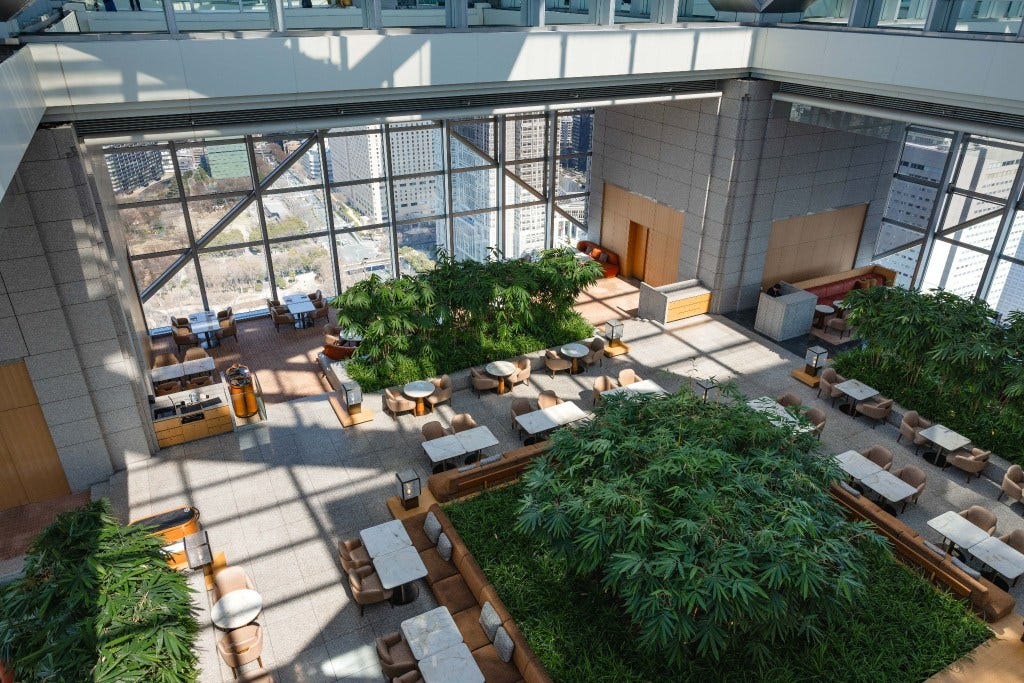
You enter at street level and rise through the building, emerging into the light and bamboo of the Peak Lounge atrium. From there, you pass through Girandole, descend into the darker intimacy of the library, move through a check-in area with the soft authority of a high-end Japanese private-wealth office, and finally enter the cocooning comfort of your room, high in the clouds above Tokyo.
It is one of hospitality’s great arrival sequences: a carefully controlled progression from city to sanctuary, brightness to shadow, public spectacle to private refuge.
So when the hotel closed for a 19-month restoration, I worried about what might happen to it. Classic hotels are often damaged not by neglect but by improvement. A new owner, designer or brand team arrives with a mandate to make its mark. Commercial concepts are inserted where they do not belong, and quirks are mistaken for deficiencies. And the Park Hyatt Tokyo sits inside Hyatt, one of the largest hotel groups in the world. It was reasonable to wonder whether corporate imperatives might overwhelm the nuances of a singular property.
When the hotel reopened in December, everyone had a quick opinion. I waited for it to settle, visited in May, and then gave myself time to process the experience. Editing a classic hotel is one of the hardest jobs in hospitality, and this one deserved more than a hot take after a four-night stay.
My verdict is that they understood the assignment almost perfectly. They executed with a light hand and a clear memory.
What Changed, What Remained
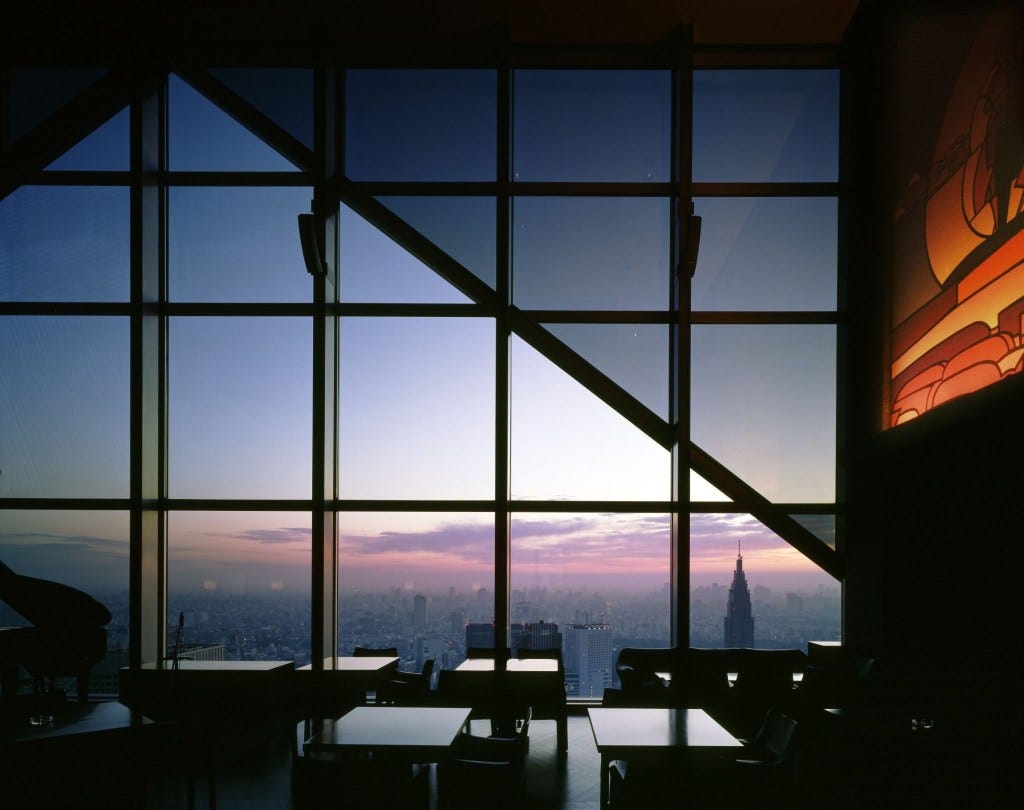
There was real commercial logic behind some of the changes. Girandole, the main-floor workhorse serving breakfast, lunch and dinner, had begun to feel underutilized during parts of the day. The collaboration with Alain Ducasse now gives it renewed purpose and panache beyond convenience. The Peak Lounge has been sharpened into a more convincing destination of its own, offering an alternative to the iconic (and busy!) bar upstairs at the New York Grill.
These are not insignificant adjustments. Hotels are businesses, and reverence for the past cannot become an excuse for weak restaurants or underperforming spaces.
The more important story, however, is what remained.
The New York Grill was freshened and then, wisely, left alone. It retains the striking gravitas that makes it one of the most singular places in the world to eat high-end Australian beef and drink big red wines while Shinjuku (and the allure of a Golden Gai nightcap) glitters below. Kozue, the Japanese restaurant, was untouched. Club on the Park still has the crisp, slightly intense atmosphere of a great Japanese executive sports club from another era: black leather lounge chairs, the iconic, cathedral-like pool, everything exuding design discipline.
And though the rooms have changed, their emotional physics have not.
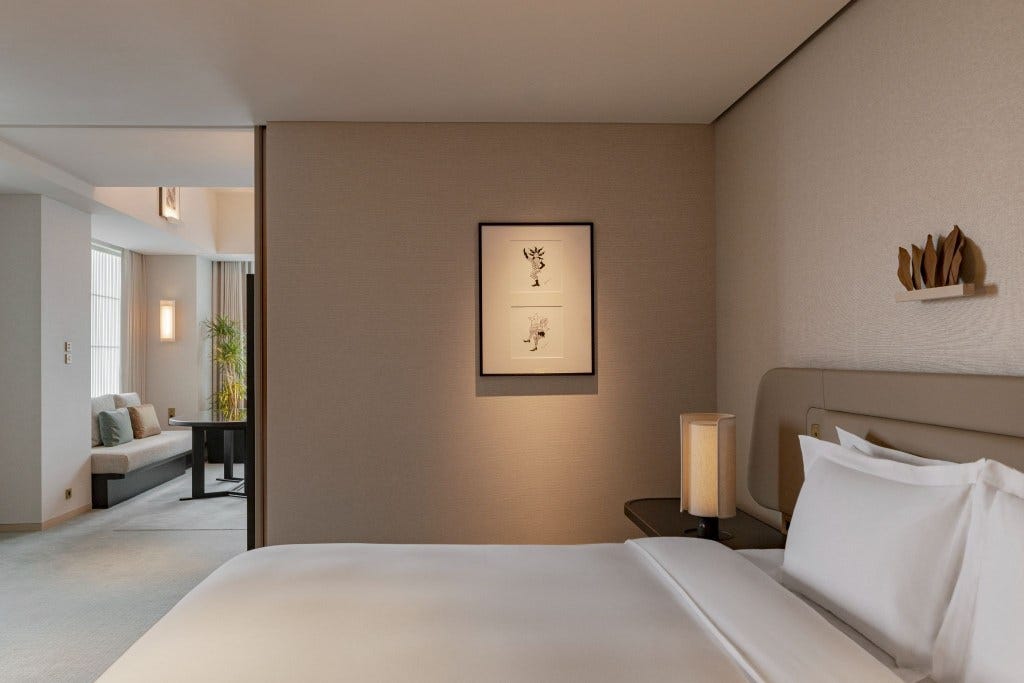
The original rooms were uncompromising in their aesthetic approach. And over time, I had developed muscle memory for them. Even in complete darkness, I could feel the precise, clear plastic knob beside the bed that controlled the lights. I appreciate the electrical socket seemingly hidden within the dark wood finishing and the perfect, small Braun travel alarm clock perched on the bedside.
The new rooms make concessions to Western guests. Plugs are easier to find, lighting is more intuitive and durable, and the headboard and beds (formerly Nihon Bed, now Sealy) have changed, along with updated seating. Some of the older furniture and stranger design flourishes have been refreshed as well.
But the emotional architecture remains intact: the rooms still feel like private observatories suspended above Tokyo. The art, books and carefully chosen objects remain. And thankfully, so do the postcards and notepads, analog gestures that many contemporary hotels would have dismissed for QR codes.
That restraint was not accidental. Several of the senior Hyatt leaders involved in the hotel’s future had once served as its general managers, including David Udell and Hervé Mazella. They understood the property as an operating organism, with rhythms that predate any brand deck. Fredrik Harfors, the current general manager, also understood the task as an edit.
At one point, a new lighting fixture was proposed for the Peak Lounge. It was rejected because it was tonally outside the world John Morford had created for the hotel. That small decision says something important, that newness was not treated as an inherent virtue. Someone was willing to say: this may be contemporary, but it does not belong here.
My Return
My first time back last May, I felt relieved. The chairs were where they should be, the books were perfectly arranged, the movement through the hotel still held together. The story had thankfully not been rewritten.
And neither had my history.
Frequent guests often talk about recognition, and hotels usually deliver it as a fruit plate with your name printed on a card. The Park Hyatt Tokyo learned me as I learned it.
Longtime members of staff would come to greet me when I arrived, sometimes even on days when they were not working. I once left clothes hanging in the closet. On my next visit, they were waiting for me, cleaned and freshly pressed. No one had bothered me about retrieving them because the underlying assumption was that I would return. Another friend, a frequent guest, also recounted that this happened to him on a side trip to Kyoto. The precision was consistent.
Aside from my early stays, I was never asked for a credit card at check-in. That’s unheard of and sends a clear message: we know you, we trust you, and we know you will settle the bill when you leave.
During the hotel’s closure, I stayed at many other excellent properties in Tokyo. Some were newer, some were more technically advanced, and some offered service every bit as polished. But the emotional depth was missing, because emotional depth cannot be installed during a renovation. It has to accumulate over time.
I thought about this when I brought my mother to the Park Hyatt Tokyo for the first time, during Hervé Mazella’s tenure. We stayed in one of the signature suites, with a Yamaha grand piano. She noticed the artwork near the entrance to the library, which changes with the seasons, and sent a postcard home bearing the same image. The berries in the room were the most beautiful she had ever seen.
There was no single extravagant gesture. It was the totality: the precision, the atmosphere, the art, the feeling of being high in the sky above an unfamiliar city. That visit permanently shaped her understanding of what elevated hospitality could look and feel like.
The Next Generation
But the deepest continuity at the Park Hyatt Tokyo has always come from its people.
Many remain. Adrian, the head concierge, still performs the honorable work of brokering Japan to excited Westerners, presiding elegantly over the arrival area and greeting guests by name. In an industry where a renovation often becomes an opportunity for quiet staff turnover, continuity of people may be the rarest amenity of all.
Before the closure, I rearranged a flight so I could have breakfast with Hideki, a longtime member of staff, on his final day at the hotel. He personified a humble, elegant form of Japanese hospitality: present without being performative, precise without being rigid, warm without ever imposing himself upon the guest.
I remember watching him leave the hotel for the last time as a member of staff and trying to imagine what it must feel like to give that much life force and effort to one place.
That memory frames the one challenge the restoration could not solve.
Senior leaders at the hotel told me how difficult it has become to find the next generation of people who see hospitality as a lifelong vocation. Many longtime staff members left during and after the pandemic and have since moved into other chapters of their lives. The pool of younger people willing to embrace the discipline, pressure and emotional intensity of this work appears smaller.
It is important not to romanticize that challenge. Hospitality at this level requires more than devotion from individual employees. It requires institutions willing to invest in training, leadership, compensation and meaningful careers. Standards this exacting cannot survive on nostalgia or institutional memory alone.
But buildings do not welcome guests. People do.
The Park Hyatt Tokyo has preserved the soft atmospherics that tell the story of the arrival: the elevator, the bamboo, the library, the dark wood, the room waiting in the clouds. It has preserved the objects, and the whimsical art and other details that turn design into character.
The task now is to ensure that the human knowledge accumulated over three decades is passed on before it walks out the door.
The restoration proves that you can go home again. But the deeper question is who will inherit the habit of returning. I was once the young guest hovering over the confirm button, daring my bank account, learning the building’s rhythms until they became muscle memory. Someone will take that place. They will notice the bronzed wristwatch, feel the elevator wind, learn which side of the building faces Fuji in December.
The hotel has done its part: it preserved the story, the sequence, the arrival. Now it must preserve the people who can read a guest’s history in the way they walk through the lobby, and who know that the highest luxury is never having to explain yourself. Get that succession right, and the Park Hyatt Tokyo does not merely survive in a competitive market. It earns another generation.