Sean Siff | March 26, 2026
The Fata Morgana Edition
On mirages, Mount Washington, and an unexpected flying experience.
Sean Siff (SS) is a private pilot who has worked in marketing in the aviation industry. He previously wrote the Flight Simulator Edition and the Adult Learning Edition.
Sean here. I got my pilot’s license back in 2011. This past December, I had the opportunity to go flying with my former flight instructor. Winter can be an ideal season for flying small airplanes: Good sightseeing conditions come on those rare days between winter storm fronts, when high-pressure systems bring cold, dense, stable air down from the Arctic. Once airborne, if there are no clouds, one can see over 100 miles in any direction. This is simply not possible in the summer—the humid air reduces visibility.
That day, there were no clouds close to our flight, giving us unrestricted views. We left Turner’s Falls Airport in central Massachusetts, and headed southeast to Hyannis for our first stop. By the time we reached 3000 feet, I could see past Block Island off our right wing, Martha’s Vineyard ahead, and Boston to my left, the glass of the skyscrapers glinting in the direct sun of the morning.
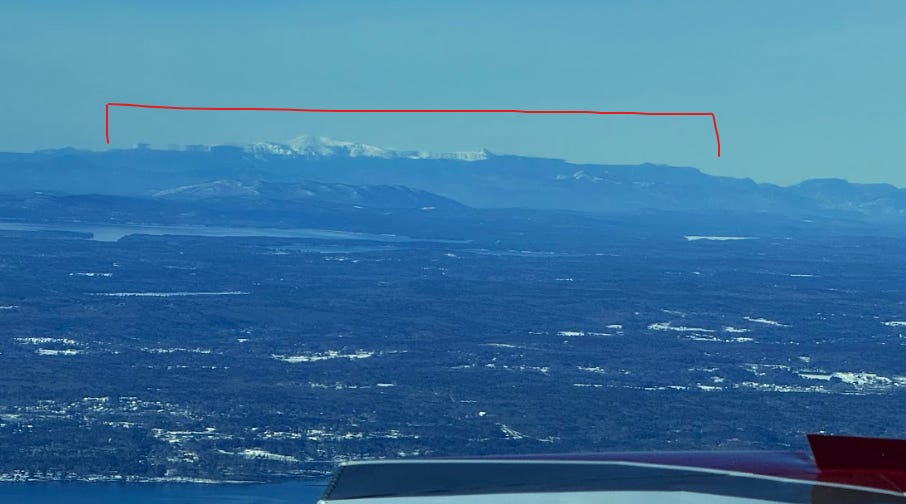
We picked up a friend in Hyannis and were back in the air on our way to Brunswick, Maine, our lunch destination. Heading north at our 8,000 feet cruising altitude, we passed the time trading stories and enjoying the unusually great weather. We could see the Presidential Range of the White Mountains, and the highest peak of Mount Washington. And yet, something was strange about the mountains’ appearance. I could see their peaks, but the natural form of the mountain range on the horizon was oddly stretched and flattened.
Startled, I removed my sunglasses, rubbed my eyes and strained forward in my seatbelt to look out over the nose of the airplane. I looked again at the mountain range and verified that the mountains were indeed oddly flattened, their peaks and valleys plateauing out, making the range far wider than its normal size. Not believing what I was seeing, I asked my flight instructor, and he confirmed it. With no other traffic nearby, we both gazed out at the mountain range, trying to interpret what we were seeing.
Why is this interesting?
Over our lunch, my instructor, who is a full-time professional pilot, recalled the condition as a Fata Morgana. I immediately thought that the term must have been borrowed from Star Wars, but in fact it’s hundreds of years old, and used to describe complex mirages that form on the horizon in rare weather conditions.
Fata Morgana is Italian for “Morgan the Fairy,” a reference to Morgan le Fay, a character from the famous legend of King Arthur stories. The term was coined in Italy, specifically in the Straits of Messina, where observers attributed floating objects like castles to le Fay’s mischief and magic.
I had assumed that mirages only form in those high-heat conditions found in deserts. (We’ve all heard stories of the weary desert-crosser searching for water, only to have their eyes deceive them.) In reality, Fata Morgana can happen in cases of temperature inversion, where warmer air moves over a body of colder, denser air. These were exactly the conditions occurring on the day of our flight. 18 hours away to the west, a storm front with warmer air from the Midwest was making its way towards New England, climbing over the colder arctic air mass already covering the region. By the next day, the warm front would cool and mix with the cold air mass below it, and New England would receive about 6 inches of heavy snow. But today, the conditions existed to form the Fata Morgana: The beginning of the warm front’s less dense air wasn’t able to push the cold air mass out of the way, so it rode up over the top of it, creating a temperature inversion.
With no clouds or humidity to obscure the horizon, we witnessed the result of the two different air masses distorting our view of the horizon, creating the mirage.
On our flight home from Brunswick, I stared out again at the White Mountain range, transfixed by what was occurring. It stretched for miles across the horizon. There was no movement present either, no heat rising to distort the view, which made it all the more unusual and unnerving. Oddly, the distortion effect reminded me of when my flight sim software incorrectly renders detailed objects, making them appear solid and uniform instead of distinct and detailed.
Having the opportunity to witness Fata Morgana from the air was unexpected, confusing and magical. I had never seen a real mirage before—I would never have imagined seeing my first one at this scale. (SS)