Michael Hastings-Black | April 16, 2026
The Antimatter Road Trip Edition
On the greatest non-contact delivery ever made.
Michael Hastings-Black (MHB) is a brand & business strategist. He runs the consulting shop AskMHB, and hosts Breakfast Club DC.
Michael here. My brother is a physicist, which means that news from his world sometimes pops on my radar. Case in point: On March 24, a truck left the CERN antimatter factory outside Geneva and drove around slowly for 30 minutes. The truck was carrying 92 antiprotons. These are individual subatomic particles, together weighing less than 1.66 x 10⁻²² grams. Scientists use antimatter to explore the asymmetries of physics, and thus our known universe.
The particles were suspended in a vacuum inside a one-ton cryogenic box cooled to -452 degrees Fahrenheit. Superconducting magnets held them in place. The truck drove carefully. Scientists monitored from the cabin. When it returned, 91 of the 92 antiprotons were still there. The scientists popped bottles of champagne.
If the antimatter had touched anything, it wouldn’t have been damaged or broken, it would have been annihilated. It would have ceased to exist in a small flash of energy, because antimatter can’t tolerate contact with matter.
Why is this interesting?
This is the first time antimatter has traveled by road. The goal is to eventually drive these particles eight hours to Heinrich Heine University in Düsseldorf, which has better experimental conditions than CERN. (Currently, CERN operates the world’s only dedicated Antimatter Factory.)
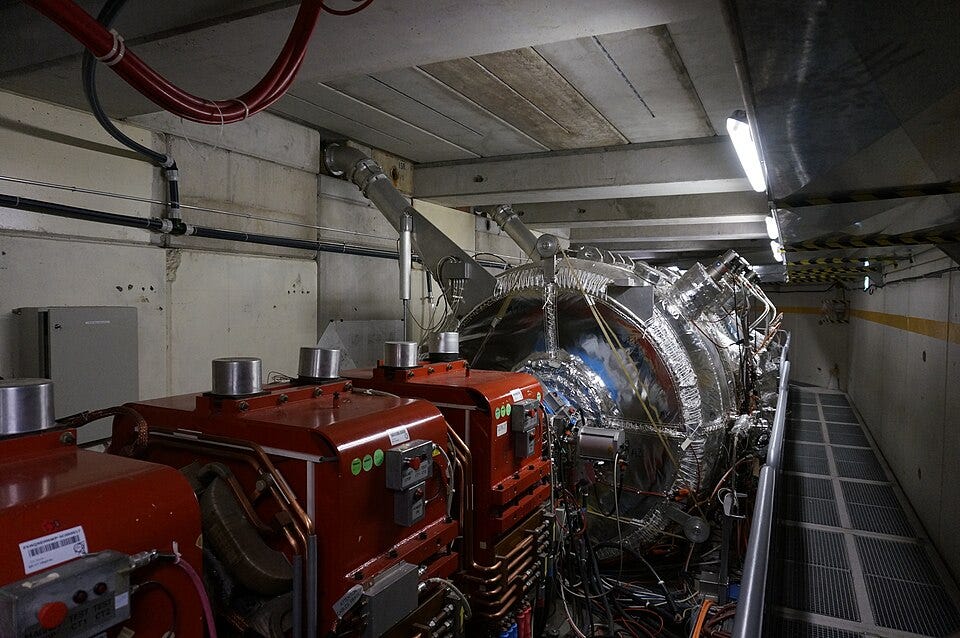
What really piqued my interest was the transit and delivery problem. The scientists needed to build a container whose only job was to keep its contents from touching anything. A box designed around the premise that the object inside can’t make contact with the physical world it’s moving through. Every wall, every surface, any molecule of gas that drifted in would be catastrophic. It’s slightly more difficult than the classic egg drop competition.
Most objects we transport around the world tolerate their containers. They sit in them, press against them, get held by them. Even the most sensitive cargo, from organs to antiquities, vaccines to wild animals, exist in material continuity with the surrounding world. Trucks, planes, containers, roads, air are all just matter in different configurations, all ultimately compatible.
Antimatter is categorically other. It’s not fragile in a way that patience and care can manage simply, because it’s constitutively incompatible with everything that exists.
The BASE-STEP trap, as CERN calls it, is compact enough to fit through a standard laboratory door, and onto a truck bed. It’s an unglamorous industrial cylinder. And it did something that we humans had never done.
We moved matter’s opposite through the world matter inhabits, and brought it home. 91 out of 92 made it. That is a remarkable survival rate for something that shouldn’t survive at all. (MHB)